
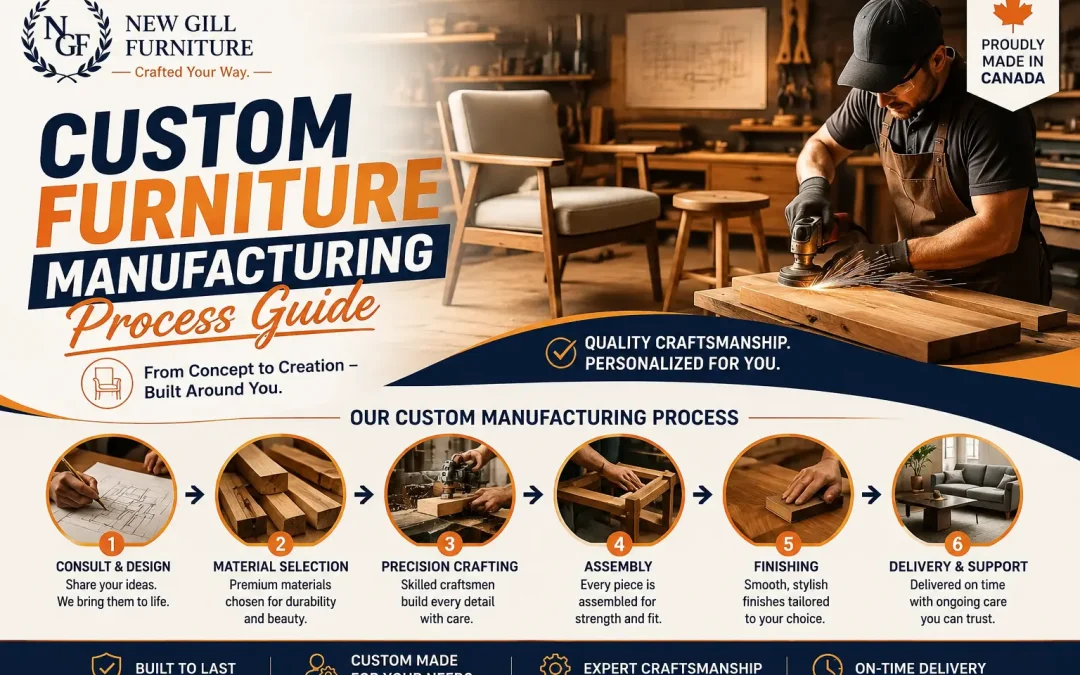
A custom furniture order is only as dependable as the process behind it. For a retailer furnishing a showroom, a designer specifying a residence, or a hospitality buyer preparing for installation, the custom furniture manufacturing process guide starts well before a craftsperson cuts the first piece of wood. It begins with clear specifications, practical material decisions, and a production plan built around the final environment.
Custom work creates room for distinction, but it also requires disciplined coordination. Dimensions, fabric performance, finish samples, lead times, freight access, and approval points all affect the finished result. A capable manufacturing partner manages those details without losing sight of the design intent.
The Custom Furniture Manufacturing Process Guide for Trade Buyers
For trade buyers, custom manufacturing should not feel uncertain or improvised. The strongest process turns a concept into an approved, repeatable product with defined checkpoints from quotation through delivery. This is particularly valuable for multi-unit residential, retail, and hospitality projects, where one late or inconsistent piece can affect an entire installation.
At New Gill Furniture, handcrafted Canadian production is supported by a practical, trade-focused workflow. The goal is to provide meaningful customization while protecting quality, timing, and consistency across a single statement piece or a larger production run.
1. Start With a Complete Project Brief
The first stage is not selecting a fabric. It is defining what the furniture must do. A useful brief identifies the product type, target dimensions, quantity, intended room, design reference, budget range, delivery requirements, and required completion date.
For upholstered furniture, the brief should also address seat comfort, cushion construction, arm and back proportions, leg style, and fabric or leather selection. For wood furniture, it should clarify species, finish color, sheen level, edge profile, hardware, and storage configuration. A bed may require a specific mattress height or headboard clearance. A hotel lounge chair may need a performance textile and construction suitable for frequent use.
Photos and inspiration images are helpful, but they are not complete specifications. A manufacturer needs measurable requirements to assess whether a design can be built as shown, should be adapted for strength, or requires a revised approach. Early clarity reduces change orders and prevents costly assumptions later in production.
Specify the installation conditions
The final setting often determines the right construction. A sectional for a condominium may need modular components that fit through elevators and narrow corridors. A dining table for a restaurant may require a more durable finish than a table intended for occasional residential use. Pieces for hospitality or public-facing spaces may also require project-specific performance standards.
This is where trade experience matters. The most attractive design is not automatically the best specification if it cannot be delivered, installed, maintained, or used as intended.
2. Confirm Feasibility, Pricing, and Lead Time
Once the brief is reviewed, the manufacturer evaluates the scope against materials, construction requirements, production capacity, and timeline. This stage should produce a clear quotation rather than a broad estimate. Trade buyers need to know what is included, what is custom, and which decisions can change the final cost or schedule.
Pricing reflects more than the visible size of a piece. A custom sofa may involve a new frame pattern, specialized foam, a difficult-to-source fabric, contrasting welt, or nonstandard leg placement. A wood casegood may require custom drawer dimensions, a matched finish, or a specific hardware solution. These details are worthwhile when they support the project, but they should be identified before approval.
Lead time also depends on the order. A repeat model in an established finish may move faster than a first-time design requiring samples or engineering review. Larger quantities can improve production efficiency, yet they may require a scheduled production window and more time for material coordination. Fast turnaround is most achievable when specifications are complete and approvals are prompt.
3. Develop the Design Into Buildable Specifications
After the order direction is confirmed, the concept moves into technical planning. This is where a design becomes a piece of furniture that can be built consistently. Dimensions are checked, construction methods are selected, and the relationship between materials is reviewed.
For wood furniture, planning may cover joinery, panel movement, drawer operation, support structure, and finish application. Solid wood brings character and long-term value, but it also responds to seasonal humidity changes. A knowledgeable manufacturer accounts for that movement rather than treating wood like a fixed synthetic material.
For upholstered pieces, technical planning considers the frame, webbing or support system, foam density, cushion style, suspension, tailoring details, and fabric behavior. A fabric that looks excellent on a flat sample may perform differently around a tight radius, deep tufting, or a heavily tailored corner. The right choice balances appearance, workability, durability, and budget.
Approvals protect the project
Before production begins, review the order details closely. Confirm overall dimensions, orientation, finish, covering, quantity, delivery location, and any special requirements. If a control sample, finish sample, or shop drawing is appropriate, approval at this stage establishes the standard for the order.
This checkpoint is especially valuable for designer-led and contract projects. It protects the client vision while giving the manufacturer a documented production reference. Once materials are ordered and production is underway, changes may affect cost, lead time, and material availability.
4. Source Materials for Performance and Consistency
Materials are selected for how they will look and how they will live. Premium hardwoods, quality veneers, durable hardware, high-density foam, carefully selected fabrics, and reliable leathers each contribute to the lifespan and perceived value of the finished piece.
For a retailer, material consistency matters across floor models and replenishment orders. For a designer, finish and textile coordination can determine whether the furniture supports the entire room. For a hospitality buyer, the priority may be cleanability, wear resistance, and replacement planning. There is no universal best material. The right choice depends on use, visual direction, maintenance expectations, and available budget.
Local manufacturing offers an advantage here. When production, sampling, and quality review are close to the project team, communication is more direct and adjustments can be handled with greater control than a distant, fragmented supply chain often allows.
5. Build the Frame and Core Structure
The structural stage determines whether furniture will remain stable and comfortable through years of use. In handcrafted wood furniture, components are cut, shaped, assembled, sanded, and prepared for finishing. Accuracy at each step affects alignment, drawer function, door reveals, and the overall feel of the piece.
For upholstered furniture, the internal frame is built first. Support components, suspension, foam, and cushioning are added before the final upholstery work begins. This order matters. A beautifully upholstered sofa cannot compensate for a weak frame or inadequate support system underneath.
Bench-crafted production gives skilled makers the ability to inspect details while they are still accessible. It also supports custom sizing and design variation without treating every project as a one-off experiment. The process remains controlled, even when the product is tailored.
6. Finish, Upholster, and Inspect Every Detail
Finishing transforms raw materials into furniture that is ready for a client-facing space. Wood surfaces are prepared carefully so stain, paint, or clear finishes appear even and protect the material appropriately. Color is reviewed under realistic lighting because a finish can read differently in a showroom, hotel lobby, or residential interior.
In upholstery, fabric or leather is cut, sewn, fitted, and tailored over the completed structure. Pattern matching, seam placement, welting, tufting, and cushion fill all influence the final appearance. Leather requires particular attention because natural grain variation is part of the material, not a manufacturing flaw.
Quality control should examine more than cosmetics. The review should include dimensions, stability, finish consistency, upholstery tension, cushion fit, hardware operation, and overall workmanship. For larger orders, an approved first piece or production sample can serve as the benchmark for the remaining units.
7. Prepare for Delivery and Installation
A finished piece is not truly project-ready until it can reach the site safely. Packaging protects corners, surfaces, legs, and upholstery during transport. For contract and hospitality orders, delivery planning should account for receiving hours, loading access, elevator size, staging areas, and installation sequencing.
Trade buyers should share site constraints early, particularly for oversized beds, sectionals, large casegoods, and assembled pieces. Sometimes a design needs knock-down legs, modular construction, or adjusted dimensions to make delivery practical. Addressing that reality during planning is far less disruptive than discovering it on installation day.
Building a Better Supply Relationship
Custom furniture works best when the manufacturer is treated as an active production partner, not simply an order destination. Share the complete vision, approve details decisively, and communicate upcoming programs or repeat needs as early as possible. That gives the production team time to reserve materials, plan capacity, and maintain the consistency your clients expect.
The right custom piece should do more than fill a space. It should reinforce the quality of your showroom, design practice, or property long after the delivery crew leaves.