

If you are specifying custom furniture pieces for a client install, furnishing a hotel block, or placing a wholesale order for your showroom floor, the lead time question needs an answer before anything else moves. Get it wrong and you are looking at pushed-back install dates, a floor with gaps in it and a buyer waiting on you for an explanation.
The honest version is that lead times in Ontario sit across a wide band and the band depends almost entirely on who is building the piece. A one-at-a-time bespoke workshop runs on a different clock than an established production manufacturer. Here is how the timelines break down, what happens at each stage and how to plan a purchase order so nothing slips.
Custom Furniture Timeline in Ontario, at a Glance
Custom furniture in Ontario typically takes 8 to 16 weeks with bespoke makers, while established production manufacturers complete standard orders in 4 to 8 weeks. Lead time depends on product type, fabric sourcing, customisation level and production volume, with multi-unit and hospitality orders requiring a 10 to 14 week minimum.
Custom furniture lead time in Ontario is the period between confirming an order with a manufacturer and the finished piece being ready for delivery or pickup. For B2B buyers including retailers, interior designers, builders and hospitality operators, this window usually spans 4 to 12 weeks and is shaped by customisation complexity, fabric and material sourcing and how full the production queue is.
Custom Furniture Lead Times in Ontario: The Real Range
Ask five Ontario makers how long a custom order takes and you will get five different answers, because they are not doing the same kind of work.
Bespoke and artisan workshops, the studios that build each piece individually by hand, generally quote 8 to 16 weeks and large or structural commissions can run to four or six months. That range shows up in most search results because it reflects the slowest end of the market.
Production manufacturers work differently. A factory with an established line, in-house materials and repeatable processes can complete a standard custom order in 4 to 8 weeks. The piece is still made to your specification. The difference is that the workflow is built for volume and consistency rather than single commissions, so your order is not sitting in a months-long personal waitlist.
For B2B buyers, that gap is the whole decision. If your install date is fixed, a manufacturer working on a 4 to 8 week cycle gives you room that a 16-week bespoke timeline does not.
When the date is tighter than that, it helps to work with a manufacturer who can flex. New Gill Furniture handles urgent and emergency orders out of its Etobicoke factory, with rush turnaround available on select pieces depending on current production load. A replacement floor sample, a last-minute hospitality order or a project where approvals came in late can often be accommodated when you raise the deadline early and confirm it at the time of order.
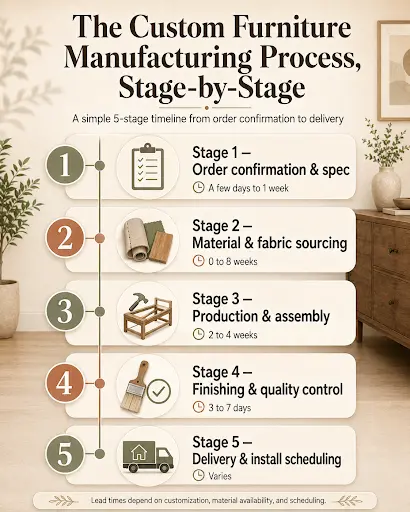
The Custom Furniture Manufacturing Process, Stage-by-Stage
Most lead-time confusion comes from treating manufacturing as a single block of time. It is not. It is a sequence and knowing what happens in each stage tells you where delays actually come from.
Stage 1: Order Confirmation and Specification (a Few Days to One Week)
The clock starts when the order is confirmed, the deposit is received and the specification is locked. Dimensions, materials, fabric or finish selections and quantities all need to be settled here. Anything left open at this stage pushes everything behind it.
Stage 2: Material and Fabric Sourcing (Zero to 8 Weeks)
This is the stage buyers underestimate most. If the manufacturer is using in-stock materials, the window can be close to zero. If you are supplying your own fabric (COM) or leather (COL) or selecting a finish that needs a mill order, the production clock does not start until that material physically arrives at the factory. A fabric quoted at 6 to 8 weeks from the mill is 6 to 8 weeks added before a single piece is cut.
Stage 3: Production and Assembly (2 to 4 Weeks)
Once specifications and materials are in hand, the piece moves onto the line. Frames are built, case goods are cut and joined, upholstery is tailored and components are assembled. On an established production line this is faster and more predictable than a single-bench build, because the steps are set and capacity is planned ahead.
Stage 4: Finishing and Quality Control (3 to 7 Days)
Finishes are applied and given time to cure before the piece is handled or wrapped. Skipping cure time is how finishes chip and wear early, so it is built in rather than rushed. The piece is then inspected before it leaves the floor.
Stage 5: Delivery and Installation Scheduling (Varies)
Lead time ends when the piece leaves the factory, not when it lands on the website. Freight, creating and install scheduling sit on top of production time and need to be planned separately. A local Ontario manufacturer shortens this window considerably compared with a piece travelling from overseas or across the country.
What Drives Custom Furniture Lead Times
Within those stages, a handful of factors move the final number up or down.
Production queue. Orders are built in sequence. When a manufacturer’s queue is full, common in September through November ahead of the holiday season and again in March and April ahead of spring staging, your order waits its turn. Quieter months like January and July tend to clear faster.
Fabric and material sourcing. Worth repeating because it is the single most common cause of a blown timeline. Confirm whether your selection is in stock before you commit to it.
Level of customisation. Standard dimensions and stock fabric combinations move fastest. Custom sizing, non-standard configurations and detailed stitching or tufting add engineering and review time.
Order volume. A single bed frame and a 30-room hotel order do not carry the same build time. Larger orders need more procurement, more scheduling and more quality checkpoints. For multi-unit work, start planning at 10 to 14 weeks.
Season. Peak periods add 2 to 3 weeks across most product categories. Ordering early in a busy season is the cheapest insurance you can buy.
Lead Times By Product Type
| Product type | Standard | Custom / COM | Peak add-on |
|---|---|---|---|
| Upholstered beds (SilkenFrame) | 4–6 weeks | 6–10 weeks | +2–3 weeks |
| Bedroom sets (wood case goods) | 5–8 weeks | 7–10 weeks | +2–3 weeks |
| Kids bedroom sets | 5–7 weeks | 7–9 weeks | +2 weeks |
| TV stands | 4–6 weeks | 6–8 weeks | +1–2 weeks |
| Coffee tables | 4–6 weeks | 6–8 weeks | +1–2 weeks |
| Storage & organisation units | 5–7 weeks | 7–9 weeks | +1–2 weeks |
| Temple & mandir units (custom) | 6–8 weeks | 8–12 weeks | +2–3 weeks |
| Hospitality / multi-unit orders | 8–10 weeks | 10–14 weeks | +3–4 weeks |
| COM / COL fabric orders | +0 (stock) | +6–8 (from mill) | varies |
These ranges reflect production at an Ontario manufacturer with an established line. Overseas alternatives typically quote 12 to 24 weeks from order to arrival at port, before customs and domestic freight are added.
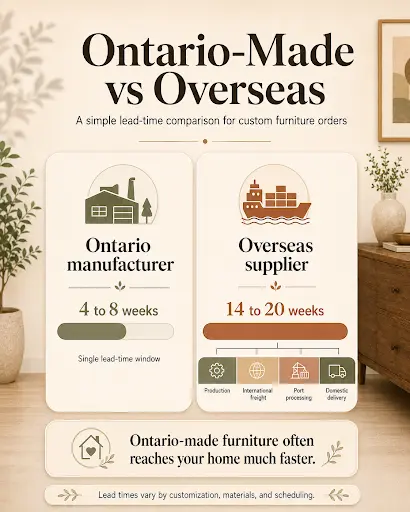
Ontario-made vs overseas: the lead time reality
Overseas pricing is appealing on a spreadsheet. The lead time gap is where it stops being a fair comparison for anyone managing a project date or a retail floor.
An Ontario manufacturer can produce and deliver a standard custom order in 4 to 8 weeks. The same order placed overseas, once you account for production, international freight, port processing and domestic delivery, routinely runs 14 to 20 weeks under normal conditions and longer during shipping disruptions like the ones the industry saw between 2020 and 2022.
For a designer working to a client’s move-in date or an operator planning a hotel opening, the difference between 6 weeks and 16 weeks is not a detail. It is a project.
What Happens After Production: Delivery, Receiving and Installation
Production time is only part of the timeline a buyer experiences. Once a piece is built, it still has to reach the website and for trade and hospitality orders that phase deserves its own planning.
Depending on the arrangement, finished furniture may go through freight shipping, delivery to a receiving warehouse, an inspection for transit damage, short-term storage until install day and then placement. Delivery, where pieces are brought in, unwrapped, positioned and the packaging removed, is the standard expectation for higher-end residential and hospitality work and it is worth confirming who handles it on any given order.
If you are a designer coordinating a full room, treat receiving and install as a distinct line item rather than folding it into manufacturing. It is where avoidable delays tend to hide.
Why Custom Furniture Takes Longer Than Retail and Why That Is The Point
Retail furniture is built ahead of demand and pulled off a shelf. Custom furniture is built after you order it, to your specification. The extra weeks buy things that matter for a piece meant to last: correct sizing, proper joinery, materials chosen for the use case and finishes given time to cure.
For buyers reselling or specifying, that is also the value you pass on. A piece built for the space, in the right dimensions and materials, is the reason a client chose custom over a catalogue in the first place. The timeline is part of the product, not a flaw in it.
How To Keep Your Custom Furniture Order On Schedule
Confirm the start date, not just the quoted weeks. Most lead times are quoted from confirmed specification and deposit. If you are supplying COM fabric, the clock starts when that fabric arrives, not when you place the order. Clarify this upfront.
Lock fabric and finish before anything else. Check stock availability before you commit to a selection. Using a manufacturer’s in-house materials removes the mill-order delay entirely.
Add a two-week buffer to every quote. Plan a quoted 6-week lead time as 8 weeks in your schedule. The buffer costs nothing. A missed install date costs a great deal more.
Prepare your details before you enquire. Dimensions, quantities, materials, delivery location and your hard deadline all speed up both the quote and the build. Have them ready at first contact.
Order earlier in peak seasons. September to November and March to April are the busiest windows for Ontario manufacturers. Place orders 2 to 3 weeks earlier than you otherwise would.
Start at 12 weeks for volume and hospitality work. Multi-unit orders need more scheduling and procurement. Ten to fourteen weeks is a more realistic planning horizon than standard retail estimates suggest.
Planning your order with an Ontario manufacturer
New Gill Furniture manufactures bedroom sets, upholstered beds through the SilkenFrame collection, kids bedroom furniture, TV stands, coffee tables, storage units and temple and mandir pieces from its Etobicoke factory, with more than 25 years of manufacturing experience behind the line. Standard orders typically ship in 4 to 8 weeks.
For urgent requirements, volume orders, or COM and COL projects, the timeline conversation is easier to have directly. Call the team at 416-748-9900, or apply to the New Gill Dealer Program to discuss lead times, delivery and logistics for your specific order.
The Bottom Line for Ontario Buyers
Lead time comes down to who you build with. Bespoke shops take their time because every piece sits in a personal queue, while a production manufacturer can hold quality and still hit a 4 to 8 week standard turnaround. New Gill Furniture is built for the second model. Our furniture is handcrafted in Canada with skilled workmanship and trusted local quality, using only fabrics, frames and finishes selected for strength, comfort and durability. When a project date is tight, our urgent manufacturing keeps fast custom builds moving so you can meet timelines that overseas suppliers cannot touch and free delivery means the cost of getting it to you is one less variable to plan around.
If you supply retail floors, design client spaces or furnish hospitality and multi-unit projects across Ontario, the New Gill Dealer Network Program is the most direct way to lock in priority lead times and wholesale terms. Call 416-748-9900 or apply to the Dealer Program to talk through your next order.
Related Article: What Is a Dealer Program and How Do Furniture Stores Join One in Ontario?
Common Questions About Ontario Custom Furniture Timelines
1. How long does custom furniture take to manufacture in Ontario?
Custom furniture in Ontario typically takes 8 to 16 weeks with bespoke makers and 4 to 8 weeks with established production manufacturers for standard orders. The exact lead time depends on product type, fabric sourcing, level of customisation and order volume. Multi-unit and hospitality orders should allow 10 to 14 weeks minimum.
2. What is the difference between a bespoke maker and a production manufacturer's lead time?
Bespoke workshops build each piece individually, which is why they often quote 8 to 16 weeks and up to four or six months for large commissions. Production manufacturers run an established line with in-house materials, so a standard custom order can be completed in 4 to 8 weeks. The piece is still made to specification; the workflow is built for consistency and volume.
3. How does COM or COL fabric affect custom furniture lead times?
When a buyer supplies their own fabric (COM) or leather (COL), the manufacturer’s production clock does not start until that material arrives at the factory. If the fabric needs a mill order, 6 to 8 weeks from the mill must be added before production begins. Choosing in-stock materials from the manufacturer removes this delay.
4. How far in advance should an interior designer order custom furniture in Ontario?
Interior designers should place standard custom orders 8 to 12 weeks before the required install date. Add 6 to 8 weeks for COM or COL fabric sourcing and plan 12 to 16 weeks for hospitality or multi-unit projects. During peak seasons of September to November and March to April, add a 2 to 3 week buffer.
5. Can Ontario furniture manufacturers handle rush or urgent orders?
Some Ontario manufacturers can accommodate urgent orders depending on current production load. Allow at least 3 to 4 weeks for a rush upholstered piece and state your hard deadline at the time of order rather than close to delivery. Working with a local manufacturer helps, because decisions can be made directly rather than routed through an overseas agent.