
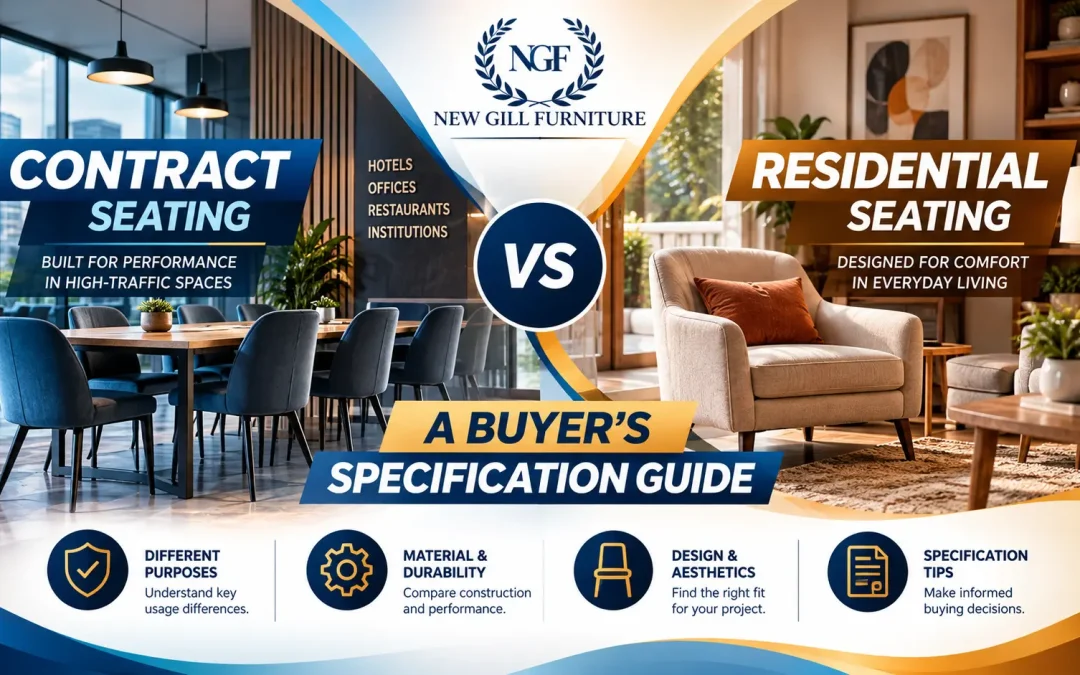
Quick answer: Contract seating is engineered for high-traffic commercial and hospitality use, while residential seating is built for comfort and lifestyle in a private home. Ontario hotels, restaurants, and multi-unit properties generally need contract-grade construction and documented compliance testing, while a low-traffic executive suite can often use a well-built residential piece instead.
A lounge chair can look equally at home in a boutique hotel lobby and a private living room, yet the specification behind it may be entirely different. For designers, retailers, and procurement teams, contract seating versus residential seating is not simply a question of appearance. It affects construction, material selection, testing requirements, replacement planning, project pricing, and long-term client satisfaction.
Contract seating refers to furniture engineered and tested for commercial, hospitality, or institutional environments, where it has to withstand frequent use by many different people under a documented set of performance standards. Residential seating is built for private homes, where use is lighter, more consistent, and driven mainly by comfort and personal style rather than compliance testing.
The right choice depends on where the furniture will be used, how often, by whom, and what the project has to withstand over time. A carefully made residential piece can be an excellent fit for a low-traffic executive suite or furnished condominium. A true contract specification is usually the better investment for a hotel, restaurant, healthcare setting, senior living community, or busy public space where performance cannot be left to chance.
Contract vs Residential Seating at a Glance
| Factor | Residential seating | Contract seating |
| Primary use environment | Private home, low and consistent traffic | Commercial, hospitality, or institutional, high and variable traffic |
| Buying priority | Comfort, style, fabric hand, personal preference | Durability, cleanability, documented performance |
| Compliance testing | Not typically required | Often required — fire safety and structural standards |
| Typical replacement cycle in a commercial setting | Can fail within 12–18 months under daily commercial use | A properly specified piece can last roughly 7–10 years |
| Best suited for | Low-traffic suites, furnished condos, private residences | Hotels, restaurants, healthcare, senior living, public spaces |
Replacement-cycle figures are illustrative industry references, not a New Gill warranty claim — see the note in the Meta tab.
Frame Construction Must Match the Use Case
The frame is where seating earns its durability. For contract applications, buyers should look beyond the visible upholstery and ask how the furniture is built. Frame joinery, wood selection, reinforcement points, suspension systems, and leg attachment all influence how a piece performs under repeated loading.
Material choice is one of the more measurable differences between the two categories. Residential wood seating is commonly made from softer woods, while contract wood seating tends to specify harder species such as maple, beech, or oak for their added resistance to scratching and stress. On metal-framed pieces, commercial specifications typically call for heavier-gauge steel than residential equivalents, since a lower gauge number means a thicker, stronger frame. A quality hardwood frame with securely joined corners provides a dependable foundation for both premium residential and contract seating, but in higher-traffic applications, additional blocking, corner bracing, and reinforced stress points become necessary, especially on arms, seat rails, back rails, and legs, the areas most likely to take force when guests push themselves up or shift furniture across a floor.
Residential seating can also benefit from this level of craftsmanship. For a designer sourcing furniture for high-end homes, a bench-crafted hardwood frame offers a stronger long-term value proposition than lightweight, mass-produced construction. The difference is that a residential project may not require every commercial-grade feature, while a hospitality project may require it as a baseline.
Suspension and Cushions Affect More Than Comfort
Seat comfort is often evaluated in a showroom within a few minutes. Long-term comfort is determined by how the suspension and cushion system recover after years of use. Webbing, springs, foam density, fibre wrap, and cushion design should be considered together rather than as isolated specifications.
For contract seating, high-resiliency foam and durable suspension systems are common priorities because they help maintain shape and support under frequent use. Loose cushions can be appropriate, but they may need more maintenance in public environments. Attached or tightly tailored cushion designs can simplify housekeeping and preserve a more consistent presentation.
For residential projects, a softer sit or a feather-blend cushion may be exactly what the client wants. The trade-off is maintenance. Plush cushion constructions can require regular fluffing and may not be the best choice for spaces where staff cannot maintain them or where turnover is high.
Upholstery, Fire Safety, and Compliance Are a Project Decision
Fabric and leather selection is one of the most visible differences between contract and residential seating. In a private residence, the client may prioritize texture, colour, and a particular natural fibre. In a hotel lounge, durability, cleanability, stain resistance, and colour consistency often carry equal or greater weight.
Contract upholstery should be selected for the environment: a restaurant banquette needs a different surface than a guest-room accent chair. Performance fabrics offer stronger abrasion resistance and easier cleaning, while contract-grade vinyl or leather may suit spaces with regular wipe-down procedures. The right material should also suit the visual standard of the property, not merely pass a technical test.
Fire and safety requirements have to be reviewed early, and they vary by location, occupancy type, and project scope. In Canada, CAN/ULC S131 is the voluntary standard commonly referenced for fire growth of upholstered furniture, and the BIFMA X5 series is widely used for structural and strength testing of commercial seating. A designer or purchasing manager should confirm which standards actually apply before approving fabric, foam, and finished seating; retrofitting a specification late in the process affects cost, lead time, and design consistency.
Residential upholstery is not automatically less durable. Many premium fabrics perform well in homes with children, pets, and active family life. A beautiful residential textile that works well in a living room, however, may not hold up to repeated luggage contact, food service, commercial cleaning products, or constant guest turnover.
The Real Cost of Getting the Grade Wrong
The upfront price gap between residential and contract seating is the easiest thing to compare and the least useful one on its own. A residential chair placed into a commercial setting is doing a job it was never engineered for, and it tends to show that quickly: loosened joints, collapsed cushioning, and upholstery failure well ahead of a comparable contract piece.
Priced over the expected service life rather than at the point of purchase, the gap usually favours the correct specification. A lower initial cost can become expensive fast when cushions lose support, upholstery fails, frames loosen, or replacement units no longer match the original installation, on top of the labour and disruption of replacing furniture in an occupied property. Overspecifying every piece is its own mistake, putting unnecessary pressure on a project budget for areas that never see heavy use. The goal is fit-for-purpose seating, specified with clear expectations, which is the same total-cost-of-ownership thinking covered in more detail in our guide to hospitality furniture sourcing.
Scale, Details, and Cleanability Matter in Commercial Spaces
Contract furniture is often specified within a larger operational plan. A chair must fit the room, but it may also need to clear a housekeeping cart, allow for accessible circulation, accommodate a cleaning routine, and withstand frequent repositioning. Details that feel minor during design development can matter a great deal after installation.
Consider exposed wood legs, deep channel tufting, decorative nailheads, loose throw pillows, or low-profile upholstery. Each can be appropriate, but each raises a practical question: will the detail collect debris, can staff clean around it, is it easy to repair if damaged, and will replacement parts or matching fabric be available for future phases?
Residential seating allows more freedom for delicate or highly personal details because the owner controls the setting and care. Contract projects demand a clearer balance between visual impact and operational reality. The best specifications do not eliminate design character. They choose details that keep looking intentional after sustained use.
Custom Manufacturing Brings Better Control
Standard, off-the-shelf seating can work for straightforward projects, but it often forces designers to compromise on dimensions, fabric, seat comfort, or finish. Custom manufacturing gives trade buyers more control over the factors that influence both fit and performance.
A hospitality buyer may need a lounge chair adjusted to fit a compact guest-room plan, paired with a specific performance textile and a wood finish that matches case goods. A design studio working on a multi-unit residential project may need consistent seating across several floor plans while varying fabrics by package level. These are not unusual requests, but they need a manufacturer that can manage repeatable production without losing attention to construction detail.
New Gill Furniture supports this kind of project work through handcrafted Canadian production, custom upholstery options, wood finishes, sizing adjustments, and trade-focused manufacturing support. For buyers managing tight installation dates, local production can also reduce the uncertainty associated with extended overseas supply chains, the trade-off explored further in our comparison of domestic and overseas furniture sourcing.
A Quick Decision Checklist: Contract or Residential?
- Is the space customer-facing, or does it see regular use by people outside one household?
- Will the piece be used for more hours per day than a typical home setting?
- Does the property face fire-safety, structural, or insurance-driven compliance requirements?
- Would furniture failure disrupt operations, create a liability concern, or damage a brand standard?
- Is the space genuinely low-traffic and privately controlled, such as an executive suite or model unit?
A “yes” to the first four generally points to a contract specification. A project that is mostly “no” across the board, such as a private residence or a controlled, low-use suite, can often be well served by a strong residential piece instead.
How to Specify the Right Seating for the Project
Start with actual conditions rather than a product category. Ask whether the setting is private or public, low traffic or high traffic, attended or unattended, easy to maintain or difficult to service. Then consider expected lifespan, budget, cleaning protocols, code requirements, and the need for future replacement.
Between the two extremes sit many hybrid projects, including furnished rentals, senior living suites, and amenity spaces, which need a more detailed conversation about how the furniture will truly be used. Before placing an order, give the manufacturer floor plans, intended use, upholstery requirements, finish direction, quantity, delivery timing, and any applicable compliance needs, information covered in more depth in our guide to trade furniture pricing. A detailed brief gives the production team what it needs to recommend a construction and material package that supports the project rather than simply filling a room.
Well-specified seating becomes part of a property’s long-term performance. When construction, upholstery, comfort, and maintenance requirements are aligned from the start, designers and buyers can deliver spaces that continue to look polished and serve guests well long after installation.
Frequently Asked Questions About Contract Seating vs Residential Seating
What’s the difference between contract seating and residential seating?
Contract seating is engineered and tested for commercial or hospitality environments with frequent, heavy use, while residential seating is designed for the lighter, more consistent use patterns of a private home. The difference shows up in frame materials, suspension, upholstery, and compliance testing.
How much longer does contract-grade seating last than residential seating in a commercial setting?
As a general industry reference, residential seating placed in a commercial setting can need replacement within 12 to 18 months, while a properly specified contract piece can last roughly 7 to 10 years. Actual lifespan depends on the specific product, materials, and how heavily it’s used.
What fire-safety and compliance standards apply to contract seating in Canada?
CAN/ULC S131 is the voluntary standard commonly referenced for fire growth of upholstered furniture in Canada, and the BIFMA X5 series is widely used for structural and strength testing. Applicable requirements can also depend on the province and the property’s authority having jurisdiction.
Can residential seating ever work in a hospitality project?
Yes, in low-traffic, privately controlled settings such as an executive suite or a furnished condominium unit. For customer-facing or high-traffic areas, a contract specification is generally the safer and more cost-effective choice over the furniture’s service life.
Does New Gill Furniture manufacture contract-grade seating?
Yes. New Gill Furniture produces handcrafted Canadian seating with custom upholstery, wood finishes, and sizing adjustments for trade and hospitality buyers who need construction built for commercial-scale use.