

If you’re a furniture store owner in Ontario, Canada, you’ve probably asked yourself: What is the profit margin on furniture and how can I improve it without constantly running sales? It’s a fair question, especially in today’s market.
With freight costs fluctuating, labour expenses increasing and competition growing from both online sellers and physical stores, protecting your margins on furniture has never been more important. Many retailers feel pressure to discount just to stay competitive. But the truth is, long-term success doesn’t come from cutting prices, it comes from buying smarter, managing stock wisely and keeping operating costs under control.
The most successful stores across Canada focus on improving their furniture store margins by building strong supplier relationships, streamlining logistics and offering products that stand out in the market. That’s exactly where the right trade partnership can make a real difference.
At New Gill Furniture, we work closely with retailers across Canada through our trade partnership program. By supplying high-quality, Canadian-made furniture directly to stores, we help retailers strengthen their furniture store profit margins without sacrificing quality or service.
So, how can you increase profitability while staying competitive in today’s Canadian furniture market? Let’s break it down in simple, practical terms.
Market Snapshot: Ontario & Canada (2025–2026)
Furniture retailers in Canada are facing margin pressure from freight volatility, higher wages, and increased online price competition. In this environment, retailers who reduce landed costs and tighten inventory control are more likely to protect profitability over the long term.
Understanding the Foundation Before the 9 Strategies

What Are Furniture Profit Margins?
For every furniture retailer and furniture store owner, profit margins are the backbone of long-term success. They determine how sustainable, scalable and resilient your business can be, especially in a competitive Canadian market.
Gross Profit Margin
Gross margin shows how much money remains after paying for the product itself.
Formula:
(Selling Price – Cost of Goods Sold) ÷ Selling Price × 100
Quick Example (Gross Margin)
If a dining table costs $650 landed (product + freight) and sells for $1,299, then:
Gross Margin = (1,299 − 650) ÷ 1,299 × 100 = 49.96% (about 50%)
Typical benchmarks in Canada:
Budget retailers: 30–40%
Mid-range retailers: 40–50%
Premium retailers: 50–60%
Improving margins on furniture starts with reducing your cost per unit. By partnering directly with the best Canadian furniture manufacturers, particularly those in Ontario, retailers can lower product costs, strengthen their furniture store margins and build healthier profit margins across Canada.

Net Profit Margin
For every furniture store owner, understanding net profit is critical. Net margin shows what remains after paying for rent or mortgage, staff wages, utilities, marketing, insurance, freight and technology systems.
Quick Example (Net Profit)
If your store does $120,000 in monthly sales and your total operating costs are $108,000, your net profit is $12,000.
Net Margin = 12,000 ÷ 120,000 × 100 = 10%
For most retailers, furniture store profit margins typically fall between 5–15% after expenses. So when someone asks, what is the profit margin on furniture? The honest answer is this: gross margins may look healthy, but true profitability depends on tight cost control and smart purchasing decisions.
Understanding Gross Margin Return on Inventory (GMROI)
Successful retailers track more than just sales. GMROI (Gross Margin ÷ Average Inventory Cost) measures how efficiently stock generates profit.
Improving GMROI means negotiating better pricing, reducing slow-moving inventory and aligning buying decisions with real demand.
Retailers who partner with the best Canadian furniture manufacturers, like New Gill Furniture, often achieve stronger returns due to better cost control and flexible pricing, ultimately improving margins on furniture across their business.

9 Proven Ways to Increase Margins on Furniture
If you’re a furniture store owner in Canada, increasing margins on furniture starts with one smart decision, buying direct.

1. Buy Direct from Canadian Manufacturers
Instead of depending on furniture wholesalers, build strong partnerships with the best canadian furniture manufacturers, especially trusted canadian furniture manufacturers in Ontario. Direct sourcing removes extra markup layers, improves pricing control and gives you access to exclusive collections.
Why This Works:
- Eliminates middleman costs
- Improves negotiation power
- Allows private-label products
- Secures consistent, reliable supply
Wholesaler Vs Manufacturer-Direct (Typical Retail Impact)
| Factor | Wholesaler Model | Manufacturer-Direct Model |
|---|---|---|
| Product cost control | Lower | Higher |
| Markup flexibility | Limited | Strong |
| Exclusivity | Rare | Possible |
| Lead times | Variable | More predictable |
| Margin potential | Moderate | Higher |
When you buy direct, your furniture store margins improve because you control costs at the source.
For home furniture retailers, exclusivity reduces price-matching pressure.
For office furniture retailers, bulk production lowers project costs.
For modern furniture retailers, custom designs strengthen brand identity.
2. Strengthen Your Supplier Negotiation Strategy
Smart negotiation protects furniture store profit margins.
Ask for:
- Volume-based pricing tiers
- Early payment discounts
- Private labelling rights
- Flexible production schedules
Long-term partnerships with Canadian furniture manufacturing experts create stability, reduce volatility and help you build stronger, more predictable profits across Canada.
3. Optimise Shipping and Domestic Logistics
Across Canada, smart logistics can make a real difference to margins on furniture. For any growing furniture store owner, every dollar saved on freight helps improve overall furniture store profit margins. The key isn’t just moving products. It’s moving them efficiently.
You can reduce logistics costs by:
- Consolidating regional shipments to avoid half-empty trucks
- Negotiating better long-term carrier contracts
- Minimising partial or rush deliveries
- Improving warehouse layout for faster handling
When products move faster and more efficiently, storage costs decrease and damage risks drop. Strong logistics discipline supports healthier overall store profitability and creates a more reliable supply chain across Canada.
4. Improve Your Markup Strategy
Not every item in your showroom should carry the same markup. A smart pricing strategy protects furniture store margins while keeping you competitive in the market.
Segment your products based on:
- Demand and sales velocity
- Brand recognition and strength
- Exclusivity of the collection
- Competitive price comparison
High-demand items may require sharper pricing, while exclusive Canadian-made collections from trusted trade partners can support higher margins. Strategic pricing allows a furniture retailer to grow profits without pushing customers away.
5. Optimise the Omnichannel Experience
Today’s buyers almost always research online before visiting a store. A smooth digital and in-store journey strengthens trust and improves furniture store profit margins.
To improve results:
- Provide clear product descriptions and dimensions
- Display transparent pricing
- Show in-store displays online
- Offer simple pickup or delivery options
A seamless experience increases customer confidence, boosts conversion rates and helps every furniture store owner improve overall margins on furniture.
6. Increase Inventory Turnover
Inventory directly affects cash flow and profitability. Slow-moving stock ties up capital and weakens gross retail returns.
To increase turnover:
- Monitor stock ageing reports regularly
- Clear slow-moving products quickly
- Track GMROI monthly
- Reorder proven bestsellers
Retailers partnering with furniture manufacturers in Ontario through trade programs can often negotiate flexible production runs, reducing the risk of overstock. Faster turnover improves cash flow and strengthens long-term furniture store profit margins.
7. Reduce Labour Inefficiencies
For every furniture store owner, labour is one of the biggest operating costs. When your team works efficiently, you strengthen profit performance across the business. The goal isn’t to cut staff, it’s to work smarter.
You can improve efficiency by:
- Cross-training team members so they can handle sales and operations
- Aligning staff schedules with peak customer traffic
- Automating inventory management systems
- Tracking clear sales performance KPIs
When your team works efficiently, you protect your bottom line while maintaining service quality. That means better customer experiences and healthier profits at the same time.
8. Increase Sales Per Square Foot
Every showroom must earn its keep. To increase profitability on furniture, measure your sales per square foot regularly.
Track:
- Sales per square foot
- Conversion rates
- Display effectiveness
Even small layout changes or refreshed displays can boost revenue. A well-designed space encourages customers to stay longer and buy more.
9. Differentiate Through Exclusive Product Lines
Competing only on price will shrink margins on furniture. Instead, stand out.
Partner directly with Canadian furniture manufacturers in Ontario through trusted trade programs like we provide at New Gill Furniture. Develop private-label collections, offer customization options and highlight true Canadian craftsmanship.
Exclusive products strengthen brand loyalty and help every furniture store owner maintain stronger furniture store profit margins across Canada.
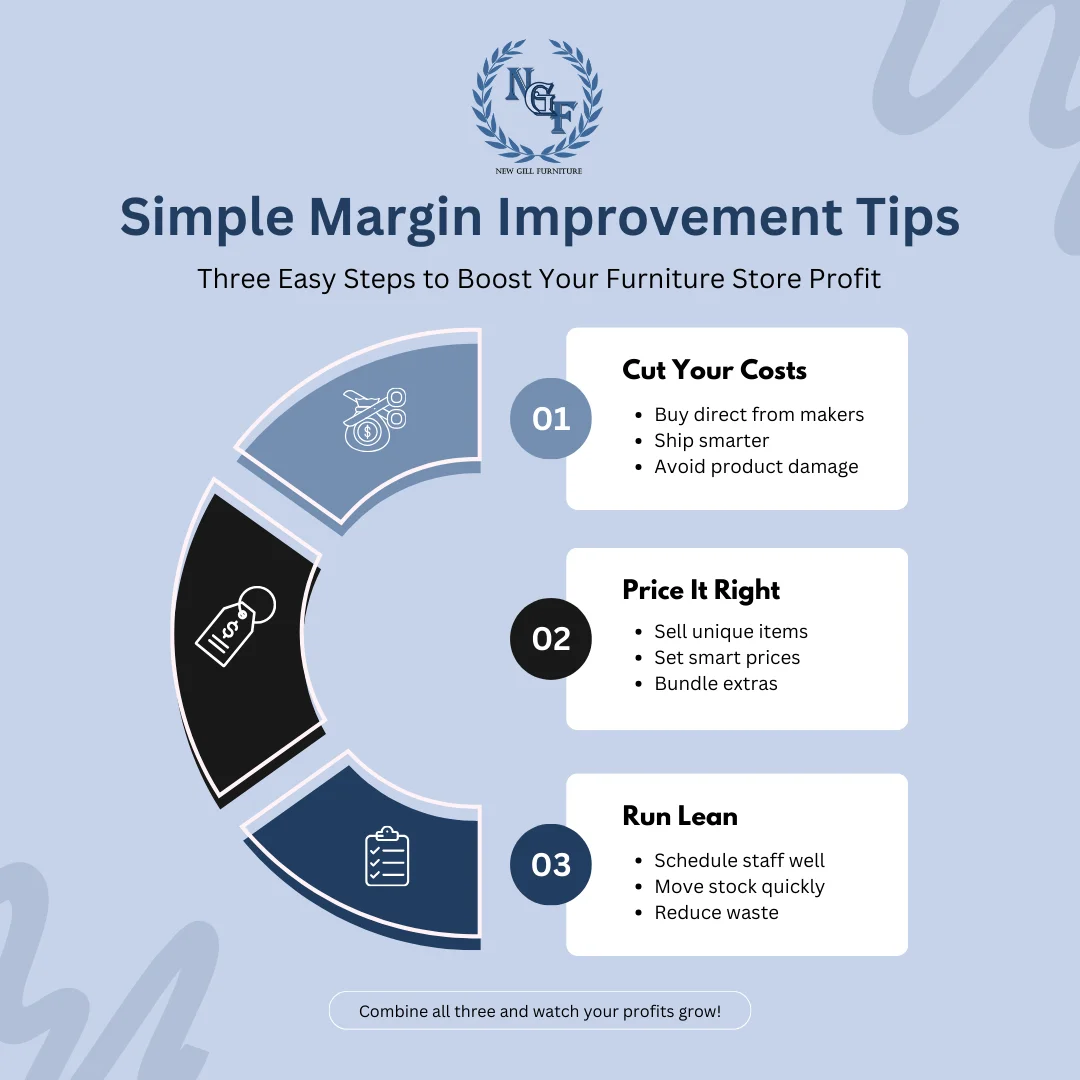
Challenges to Increasing Furniture Store Margins
For any furniture store owner, growing showroom profitability isn’t always simple. Even when sales are steady, outside pressures can shrink your margins on furniture if you’re not careful.
1. Changing Customer Preferences
Today’s Canadian buyers are more informed and selective than ever.
They want:
- Sustainable materials
- Custom finishes
- Multi-functional furniture
- Strong value for money
Customers are no longer just buying a sofa or dining table, they’re investing in lifestyle, flexibility and long-term quality. If your inventory doesn’t reflect these expectations, stock can sit on the floor too long. Slow-moving products tie up cash flow and directly impact furniture store profit margins.
That’s why smart sourcing matters. Working with trusted Canadian suppliers allows retailers to adapt faster without overstocking.
2. Increased Competition
Competition has also intensified. Retailers are up against:
- Online marketplaces
- Big-box retailers
- Discount chains
To protect your position as a furniture retailer, you need more than competitive pricing.
You need:
- Strong sourcing partnerships
- Clear brand positioning
- Excellent customer service
- Exclusive product collections
Retailers who focus on differentiation, not just discounts, are the ones who successfully protect and grow their store-level profitability across Canada.
Other Financial Metrics to Monitor
As a furniture store owner, looking only at basic profit percentages isn’t enough. To truly increase profitability on furniture, you need to track the right performance numbers.
Gross Margin Return on Inventory (GMROI) measures how efficiently your stock generates profit. If your GMROI is low, your inventory may be tying up cash instead of producing healthy returns.
Furniture Sales Per Square Foot evaluates how productive your showroom space is. Strong layout planning and the right product mix can significantly enhance financial performance.
Cash Flow ensures stability during slower seasons and larger purchasing cycles. Healthy cash flow protects your business and supports long-term growth.
Mastering Furniture Store Margins for Long-Term Success
For retailers in Ontario and across Canada, sustainable growth depends on cost control, efficient inventory management and strong supplier relationships.
Working directly with Ontario-based manufacturers gives furniture store owners better pricing control, consistent product quality and improved supply stability. When procurement decisions are strategic and inventory turnover is monitored closely, financial performance becomes more predictable.
Long-term success comes from disciplined purchasing, operational efficiency and a clear retail strategy, not constant discounting.
Final Thoughts
So, what is the profit margin on furniture?
It comes down to sourcing strategy, expense management and product positioning. Stores that reduce unnecessary markup layers and build reliable manufacturer relationships are better positioned to compete in today’s market.
If you want to improve margins on furniture, the best place to start is at the source. Partnering directly with trusted Canadian manufacturers reduces unnecessary markups, improves product consistency and protects your bottom line. That’s where New Gill Furniture makes a difference.
As a Canadian supplier offering trade partnerships to retailers across the country, New Gill Furniture provides high-quality, Canadian-made collections designed to help you increase furniture store profit margins while staying competitive.
In today’s fast-moving Canadian market, mastering margins on furniture isn’t optional, it’s essential for long-term growth and success.
FAQs on How Furniture Store Owners Can Increase Margins
1. How to get a 70% profit margin in furniture retail?
A 70% gross margin is possible when retailers control product costs and sell premium or exclusive collections. This usually requires sourcing directly from manufacturers, reducing freight expenses and applying smart category-based markups. New Gill Furniture helps retailers access Canadian-made collections without unnecessary middlemen, improving margin potential.
2. What is the average profit margin in the furniture industry?
In Canada, gross margins in furniture retail typically range from 30% to 60%. After rent, labour, marketing and logistics expenses, net margins usually fall between 5% and 15%. Retailers who manage sourcing and inventory carefully tend to stay at the higher end of that range.
3. How much should a furniture store mark up furniture in Ontario?
Most Ontario furniture retailers apply a markup of 2.0x to 2.5x on landed product cost, depending on category and competition. Premium or exclusive collections may allow higher markups, while highly competitive items may require tighter pricing. Strategic sourcing from partners like New Gill Furniture helps maintain healthy pricing flexibility.
4. Is buying direct from manufacturers cheaper?
Yes, in most cases. Buying direct eliminates wholesaler markups and gives retailers better pricing control. It can also reduce supply chain delays and improve consistency in product quality. New Gill Furniture works directly with Canadian production partners to support better cost efficiency for retailers.
5. What is a good GMROI for furniture retailers?
GMROI (Gross Margin Return on Inventory) measures how much profit your inventory generates. A GMROI above 2.5 is generally considered healthy in furniture retail. Higher-performing stores often aim for 3.0 or more by improving inventory turnover and reducing slow-moving stock.
6. How can offering king size and queen size bedroom furniture improve profitability?
King and queen size bedroom sets usually carry higher ticket values, which increases revenue per sale. Customers actively search for these sizes, making them strong core categories. By sourcing quality Canadian-made bedroom furniture, retailers can maintain strong gross returns while meeting demand.
7. Does selling solid wood dining tables and quality couches increase margins?
Yes. Customers are often willing to pay more for durable, well-built furniture. Solid wood dining tables, premium sofas and well-crafted living room pieces support higher perceived value. New Gill Furniture provides dependable Canadian-made collections that allow retailers to justify premium pricing.
8. Why should a furniture retailer focus on bedroom sets, dining tables and couches?
These are high-demand core categories that drive consistent revenue. By sourcing king size beds, queen size beds, dining tables and couches through New Gill Furniture’s trade partnership program, retailers can secure competitive pricing and strengthen overall retail profit structure.