
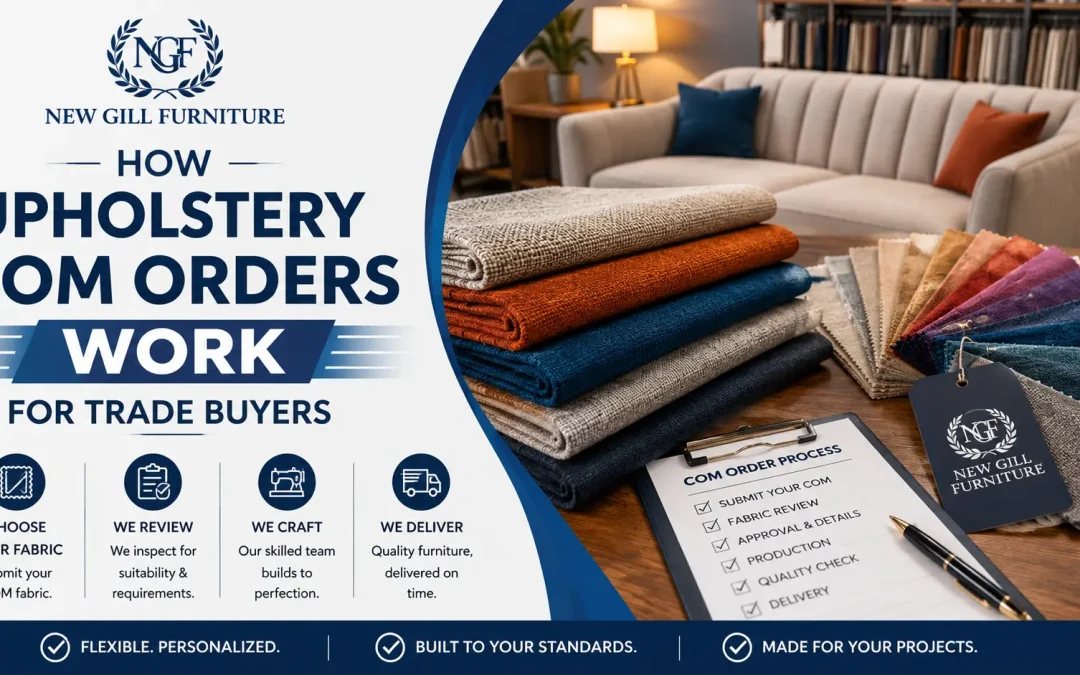
A client-approved textile can be the detail that turns a standard seating specification into a distinctive room. Upholstery COM orders give designers, retailers, and hospitality buyers the freedom to use their own selected fabric or leather while working with a trusted furniture manufacturer. The result can be highly tailored, but it also requires clear material planning, accurate approvals, and early coordination.
COM means Customer’s Own Material. Rather than selecting from a manufacturer’s stocked upholstery program, the buyer supplies the approved covering for a specific piece of furniture. For trade projects, this is often the right path when the scheme calls for a branded textile, a performance fabric from a specified mill, a contract-grade pattern, or a color that must coordinate exactly with drapery, wallcovering, or existing furnishings.
What Upholstery COM Orders Require
A successful COM order begins with more than a fabric memo. The manufacturer needs enough information to confirm that the material is appropriate for the product, calculate the correct quantity, and schedule production without preventable delays. This protects the project budget as much as it protects the finished furniture.
The order should identify the furniture model, dimensions, quantity, upholstery method, and requested delivery date. It should also include the fabric or leather brand, pattern name, colorway, SKU, fiber content, width, repeat, and any performance or fire-test documentation required for the installation. If a textile has a directional pattern, stripe, large repeat, border, pile, or noticeable shading variation, call that out before material is ordered.
For a chair upholstered in a solid, non-directional fabric, the estimated yardage may be straightforward. A large-scale floral, railroaded stripe, or fabric that must be pattern-matched can require considerably more. The same is true for sofas, sectionals, channel tufting, matching cushions, and upholstered headboards. Yardage is not simply a measurement of the furniture’s surface area. It accounts for cutting layouts, repeat matching, usable fabric width, seams, welts, cushions, and production allowance.
COM and COL Are Not the Same
COM usually refers to fabric supplied by the customer, while COL means Customer’s Own Leather. Leather is quoted differently because hide size, shape, yield, scars, natural grain variation, and required panel cuts affect how much usable material is available. A leather that is beautiful for a small accent chair may not provide the consistency or hide yield needed for a long sectional.
Buyers should avoid treating fabric yardage and leather hide requirements as interchangeable. A manufacturer should review the selected leather and calculate the required square footage or hide count for the exact frame and upholstery details.
Confirm Material Suitability Before Purchase
Not every attractive fabric is suitable for every application. That distinction matters most on high-use seating and commercial projects, where a premature failure can affect the designer, retailer, and property operator long after installation.
For residential furniture, the primary questions are often durability, cleanability, hand feel, colorfastness, and how the textile will perform around pets or children. For hospitality, multifamily, healthcare, and other commercial environments, additional requirements may apply. These can include abrasion performance, flammability compliance, stain resistance, antimicrobial treatments, bleach-cleanable specifications, or documented performance standards required by the project.
The manufacturer should also assess construction concerns. Very lightweight fabrics may need backing or may not be appropriate for deep tufting. Open weaves can snag or shift. Vinyls and coated materials may need special handling at seams. Velvet, chenille, boucle, and other pile fabrics can show shading depending on the direction of the nap. These characteristics do not automatically disqualify a material. They simply need to be understood before production begins.
A physical cutting is more useful than a digital image. Screen color is unreliable, and a memo sample rarely reveals every characteristic that appears across a full roll. When possible, approve a larger sample in the actual project lighting and alongside nearby finishes. This is especially valuable for off-whites, warm grays, dark navy tones, and materials with a visible texture.
The Approval Process That Protects Your Project
COM furniture is custom production, so approvals should be documented before a frame enters the upholstery schedule. The best orders establish a clear chain of responsibility: the buyer approves the furniture configuration, the manufacturer confirms material requirements, and the fabric supplier sends the correct goods to the designated receiving location.
Before shipping material, verify the purchase order number, customer name, furniture style, number of pieces, fabric reference, yardage or hide requirement, and receiving instructions. The fabric should arrive in its original packaging whenever possible, with labels intact. Material shipped without identification can create delays while the receiving team works to match it to the correct order.
It is also wise to send a control sample or approved memo with the goods. This gives the upholsterer a direct reference for color, pattern, and orientation. For striped, patterned, or directional textiles, include written placement instructions. For example, state whether a stripe should run vertically on the chair back, whether cushion tops must align, or whether a pattern repeat should be centered on an upholstered bed panel.
Written instructions are particularly valuable when the project has several pieces or multiple delivery phases. Assumptions made at the start of one order can become costly inconsistencies on a repeat order months later.
Build Realistic Lead Times Into the Specification
COM does not have to mean slow production, but the clock cannot start until the required material, approvals, and order details are complete. A dependable manufacturer can provide fast turnaround, yet production timing still depends on fabric availability, freight transit, receiving inspection, the complexity of the upholstery work, and current capacity.
For deadline-sensitive installations, secure the fabric early. Some designer textiles have extended mill lead times, limited dye lots, or restricted inventory. If the specified fabric is backordered, the furniture schedule will be affected unless an approved alternate is available.
Buyers should also plan for inspection at receipt. The manufacturer will generally check the quantity, visible condition, and identification of incoming material. That process is necessary, but it does not always transfer responsibility for hidden defects, dye-lot variation, fabric flaws, or issues that only become apparent during cutting. Since COM is customer-supplied, policies commonly limit the manufacturer’s responsibility for the performance or replacement of the material itself.
Ordering a reasonable overage can prevent a small issue from becoming a major delay. The right amount depends on the textile, the order size, and the project risk tolerance. It is especially prudent for discontinued goods, custom-dyed materials, large repeats, matched pieces, and installations that may require future repairs.
Specify the Details That Make Furniture Look Intentional
The covering is only one part of the finished result. Upholstery COM orders should be reviewed alongside the rest of the specification: cushion construction, seat firmness, welt or self-welt, topstitching, button tufting, nail trim, leg style, wood finish, cushion count, and sectional configuration.
A fabric that looks refined on a tight upholstered dining chair may behave differently on loose seat cushions. A bold pattern may suit a single lounge chair but become visually busy across a large sectional. Likewise, contrast welts can elevate a custom silhouette, but they add cutting requirements and require enough coordinating material.
For retailers, maintaining a clear COM protocol helps sales teams set accurate expectations with customers. For designers, it helps preserve design intent from presentation through installation. For procurement teams, it creates a record that supports consistent repeat purchasing across rooms, properties, or locations.
At New Gill Furniture, handcrafted Canadian production and trade-focused custom support make it possible to coordinate upholstery, sizing, finishes, and design details as part of one considered specification. The strongest projects start with a practical conversation about the material, the frame, and the performance expectations before the order is released.
Common COM Mistakes to Avoid
The most common problems are rarely caused by the upholstery itself. They begin with incomplete information: ordering yardage before confirming the frame, assuming a memo represents the full fabric, shipping goods without an order reference, or overlooking repeat direction and material suitability.
Another frequent issue is changing the fabric after production has been scheduled. A fabric substitution may alter yardage, lead time, suitability, or visual placement. When a change is necessary, it should be reviewed as a new approval point rather than treated as a simple administrative update.
Finally, do not leave quality expectations unspoken. If a project requires exact pattern centering, matched cushions, railroaded application, or a specific leather grain selection, include those requirements in writing before cutting begins. Some expectations are achievable; others may involve added material, labor, or natural variation. Knowing the trade-off early allows the team to make the right decision.
COM is most valuable when it gives a project greater control without creating uncertainty. Specify carefully, secure the right amount of approved material, and involve the manufacturer before the textile is purchased. That preparation gives every handcrafted piece the best chance to arrive looking intentional, performing as specified, and supporting the standard your client expects.