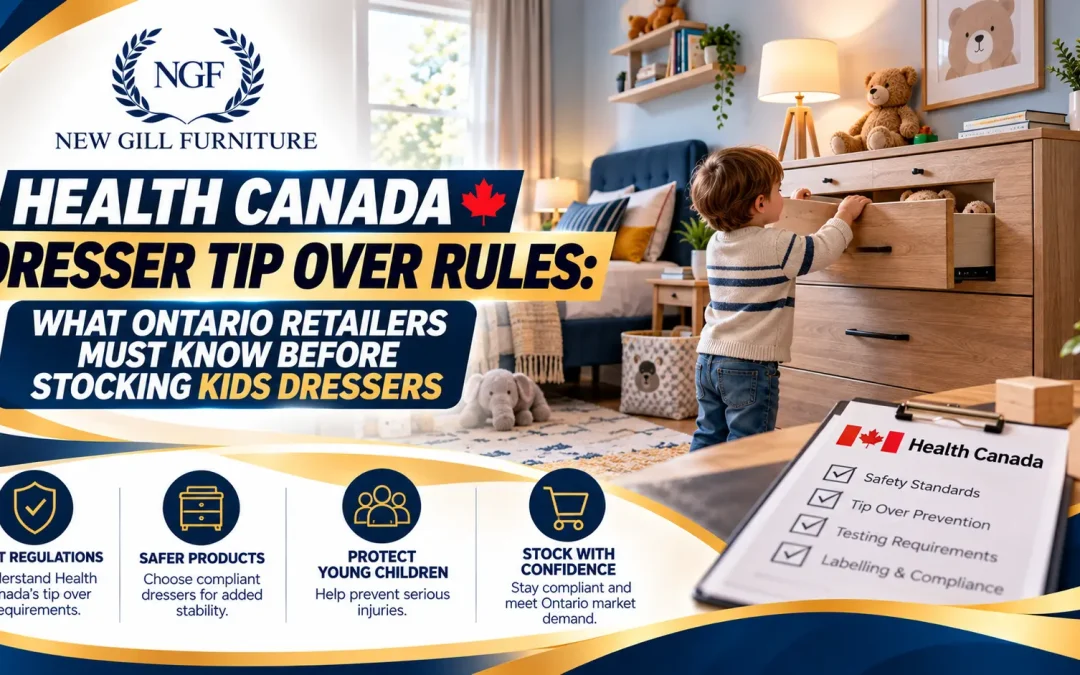
The dresser tip over standard Canada now enforces is ASTM F2057-23 and it changes what Ontario furniture retailers can legally keep on their floors and websites. If a dresser, chest or armoire in your store falls within the rule and does not meet the 2023 edition, Health Canada treats it as a danger to children.
As of March 31, 2026, Health Canada updated its General Prohibition Table 3 under the Canada Consumer Product Safety Act (CCPSA) to reference ASTM F2057-23 for free-standing clothing storage units. That replaced the 2019 edition. For retailers in Toronto and across Ontario, the practical job is clear: confirm which units are in scope, get current test documentation from every supplier and remove anything that cannot be supported. This guide walks through the scope, what changed, a stocking checklist and the questions to ask your manufacturer.
What do Ontario Retailers Need to Know About Dresser Tip Over Rules?
Since March 31, 2026, Health Canada treats free-standing dressers, chests and armoires that fail ASTM F2057-23 as a danger under the CCPSA. Ontario retailers should stock only units with test reports citing the 2023 edition, check warning labels and anchoring kits and pull any unit without current documentation from sale.
What Is the Dresser Tip Over Standard in Canada?
The dresser tip over standard in Canada is ASTM F2057-23, the Standard Safety Specification for Clothing Storage Units, which Health Canada references when deciding whether a free-standing dresser, chest or armoire poses a danger to human health or safety. Products that do not conform to it or an equivalent standard, cannot be manufactured, imported, advertised or sold in Canada, including at retail stores in Toronto and across Ontario.
Does the Rule Apply Only to Kids’ Dressers?
No. The rule covers free-standing clothing storage units in general, not only children’s furniture. Kids’ bedroom pieces deserve extra attention, though, because young children are the ones who climb drawers and pull on handles.
Which Units are in Scope?
A free-standing clothing storage unit falls under the rule when it meets all three of these thresholds:
| Measurement | Threshold |
| Height | 27 inches (686 mm) or taller |
| Weight | 30 lb (13.6 kg) or heavier |
| Enclosed storage volume | 3.2 cubic feet (90.6 dm³) or more |
This includes dressers, chests, drawer chests, bureaus, door chests and armoires.
Which Units are Excluded?
Units built into a wall or permanently attached to a structure are excluded. So are units that fall below any of the three thresholds. Bookcases, shelving, entertainment furniture, office furniture and jewellery armoires are also outside this specific rule.
Excluded furniture can still tip. Health Canada has long warned about television and furniture tip-overs in homes with young children, so anchoring advice still applies to TV stands and tall storage pieces.
What Changed Between ASTM F2057-19 and F2057-23?
The 2023 edition tests dressers under conditions closer to how children actually use them. Health Canada concluded that the 2019 edition may no longer be protective enough.
Key Changes in the 2023 Edition
- Heavier test weight. Testing uses a 60 lb weight that represents children up to about six years old.
- Carpet and hard floors. Stability is tested on both hard and carpeted surfaces, since many bedrooms have carpet.
- Multiple drawers open. Units are tested with more than one drawer open at the same time.
- Dynamic force test. A test simulates the weight and motion of a child climbing or playing on the unit.
- Wider product scope. Armoires, door chests and chifferobes are explicitly included.
- Stronger warnings. Warning and labelling requirements were updated.
Is There a Grace Period?
No legislated transition period applies. The CCPSA general prohibitions were already in force and the Table 3 update changed the referenced edition. Health Canada has said it will focus first on compliance promotion. Enforcement tools such as recalls, seizures and orders are still available immediately.
Why Does This Matter for Toronto Furniture Retailers?
Retailers are part of the supply chain the CCPSA covers. Selling or advertising a product that poses a danger is prohibited, whether the unit sits on a showroom floor in Toronto or appears on your website.
Health Canada Checks Products After They Reach the Market
Health Canada does not approve products before sale. It enforces compliance after products reach the market, through sampling, testing and recalls. In past compliance projects, inspectors bought dressers from retail stores and tested them at Health Canada’s lab.
Recalls Affect Retailers Directly
Past Canadian dresser recalls have required stores to stop selling affected models. The CCPSA prohibits recalled products from being redistributed, sold or even given away in Canada. Holding stock you cannot sell ties up cash and floor space.
The Risk Is Real
Health Canada reported 90 incidents involving furniture tip overs in Canada between June 2011 and September 2024, including 12 deaths and 42 injuries. Behind each number is a family and most families trust that what their local store sells has been checked.
How Should Retailers Check Dressers Before Stocking Them?
Use this checklist for every clothing storage unit you carry or plan to order.
Measure Your Current Inventory
List every dresser, chest and armoire on your floor, in your warehouse and on your website. Record height, weight and storage volume so you know which units fall within the rule.
Request Test Reports That Cite the 2023 Edition
Ask each supplier for a test report from an accredited laboratory that references ASTM F2057-23. Reports referencing only the 2019 edition should be treated as insufficient. Keep copies on file by model number.
Review Older Stock
Pieces bought before 2026 may have been tested only to the 2019 edition. Ask your supplier whether those models were retested and set aside any unit you cannot document.
Check Warning Labels
Confirm that each unit carries the warning labels the 2023 edition requires. If a label is missing or damaged, contact the manufacturer before selling the piece.
Confirm Anchoring Hardware
Ask whether each unit ships with a tip restraint or anchor kit and clear installation instructions. Anchoring adds protection, though it does not replace passing the stability tests.
Update Online Listings
The prohibition covers advertising, not just sales. Remove or pause product pages, marketplace listings and social posts for any unit you cannot document.
Anchor Floor Models
Children visit showrooms with their parents. Secure display dressers and chests so a climbing child cannot pull one over on the sales floor.
Train Your Sales Team
Give staff a short script on why anchoring matters and how to install the kit. Parents in Toronto condos and rental apartments often worry about drilling into walls, so staff should be ready to explain the options.
Watch for Recalls
Check the Government of Canada Recalls and Safety Alerts site regularly for dresser and chest recalls. Pull affected models from sale as soon as a recall is posted.
Know Your Reporting Duties
The CCPSA requires manufacturers, importers and sellers to report certain safety incidents to Health Canada within set timelines. Confirm your obligations with Health Canada or legal counsel and keep a written process ready.
What Should You Ask Your Kids Bedroom Furniture Manufacturer?
Clear answers protect your store, your customers and your margins. Ask these questions before you add any clothing storage unit to your floor:
- Which of your dressers, chests and armoires meet the scope thresholds?
- Do you have accredited lab test reports citing ASTM F2057-23 for each model?
- Were older models retested to the 2023 edition?
- Which warning labels are applied and where on the unit?
- Does each unit ship with an anchor kit and installation instructions?
- How will you notify us of a recall or design change?
- Who is our contact for safety documentation?
Get every answer in writing and store it with your purchase records.
Why Work With a Canadian Manufacturer on Kids Bedroom Furniture?
Buying from a manufacturer close to home makes documentation conversations faster. You can visit the factory, review pieces in person and get answers from the people who build the furniture.
At New Gill Furniture, we have been building wood and upholstered furniture in our Etobicoke facility since 2002 and our family business is now led by the second generation. As a Canadian Furniture Manufacturer Ontario retailers can visit, we welcome safety questions before you place an order. Explore our Kids Bedroom Furniture Ontario range, then talk to our team about specifications and documentation for the pieces you plan to stock.
This article is general information for trade buyers, not legal advice. For decisions about specific products, refer to Health Canada and qualified legal or testing professionals.
Frequently Asked Questions
What is the dresser tip over standard in Canada?
Health Canada references ASTM F2057-23 for free-standing clothing storage units. Units in scope that do not meet it are treated as a danger under the Canada Consumer Product Safety Act and cannot be sold or advertised.
Does the rule apply only to children’s dressers?
No. It applies to free-standing dressers, chests, bureaus, door chests and armoires that are at least 27 inches tall, weigh 30 lb or more and have 3.2 cubic feet or more of enclosed storage. Kids’ bedroom pieces need extra attention because young children climb drawers.
Can I still sell dressers tested to ASTM F2057-19?
Health Canada now considers the 2019 edition potentially insufficient. Ask your supplier for test reports citing the 2023 edition and confirm any older stock with Health Canada or qualified professionals before selling it.
Does an anchor kit make a dresser compliant?
An anchor kit adds protection in the home, but the standard also tests the unit’s own stability. Ask your manufacturer for both an F2057-23 test report and anchoring hardware.
Where can I check for dresser recalls in Canada?
Health Canada posts consumer product recalls on the Government of Canada Recalls and Safety Alerts website. Check it regularly and stop selling any recalled model immediately.
If you are reviewing your kids bedroom assortment for 2026 and want a supplier you can talk to directly, contact our team. Bring your model list and questions and we will walk you through specifications, anchoring hardware and documentation for the pieces you plan to carry. Request our 2026 furniture catalogue, visit our Etobicoke factory showroom or contact New Gill Furniture at 416-748-9900. Retailers interested in an ongoing partnership can also ask about our Dealer Network Program.
Kids Bedroom Sourcing Tips and Guides
- Kids Bedroom Furniture Wholesale for Trade Buyers
- A Guide to Quality Control in Furniture Manufacturing in Ontario
- Supplier Reliability Review for Furniture Buyers
Sources:
- Eurofins: Health Canada elevates CSU stability requirement to ASTM F2057-23
- Bureau Veritas: Health Canada accepts ASTM F2057-23 criteria
- Canadian Wood Industry: Health Canada tip-over warning
- Health Canada: DHHS assessment for free-standing CSUs
- Health Canada: Compliance Verification Project 2021–2022, Furniture Tip Over
- Health Canada recall: Homestar Finch dresser
- Woodworking Network: Canada proposing tougher CSU standard